Tuesday, November 13, 2018

Single Premium ULIP plans vs Regular Premium ULIP plans

Individuals who are disciplined for regular investing and looking for a good long term investment option backed with life cover and do not mind the 5-year lock in period should be investing in regular premium ULIPs.

There has been a recent spike in the sale of single premium ULIP plans as compared to regular premiums. In the single premium plan, an insurer gets coverage for full term by paying premium amount in a lumpsum. Whereas, in regular premium ULIP plan, an insurer needs to pay premiums in intervals such as monthly, quarterly, half-yearly or annually for the policy.

The private sector insurers registered a hike in the growth of 54.75% in the single premium segment in April-June 2018 at the same time the regular premium grew just 3.84% during the same period.

Investors have taken into account the Long Term Capital Gains (LTCG) tax on equity mutual funds, post the announcement in the Union Budget and hence there was an overall growth in ULIP sales. New plans have lower charges and are more transparent so it's gaining investors' confidence. Let's understand key differences between single premium and regular premium ULIP plans for investors to take informed decisions before opting for one.

Why investors are opting for single premium ULIP plans?

While buying a single premium ULIP plan, a buyer of the policy needs to have a lumpsum amount to invest in existing or new schemes getting launched.  Lumpsum investors have always been a key chunk of the market. This is mainly because a good proportion of the customers have a good amount of investible surplus right now, but they shy away from the commitment of recurring investments in regular premium ULIP plans.

We see a spike in sales as many companies are launching single premium insurance plans where product offering and pricing is better than the existing plans."

Who should be investing in single premium or regular premium ULIP plans?

Single premium ULIPs should be bought by individuals who can afford its expensive premium. Even individual with uneven cash flows can invest in such a mode as their future premiums might be uncertain.

Investors who have unexpected windfall gains like bonuses, profits, huge income from property sale, etc. also investing their gains in these single premium plans.

Lastly, individuals who want to avoid the hassle of regular payment of premium should be investing in the single premium plan.

Individuals who are disciplined enough for regular investing and looking for a good long term investment option backed with life cover and who do not mind the lock in period of 5 years should be investing in regular premium ULIPs

The positives and drawbacks of single and regular premium ULIP plans

Table 1_ULIP story

Illustration of fund value comparison in single premium vs regular premium ULIP plans
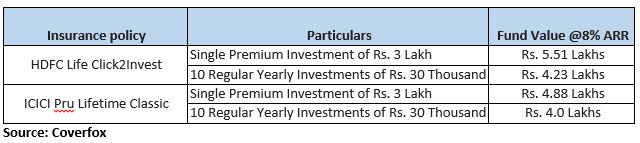
In ULIP products, the premiums remain same since you choose how much you want to invest. It is the output, the maturity amount that differs, basis the cost of the product, which is a net of all the charges it deducts and the additional allocations it gives. Also, you cannot simply compare the maturity fund values for regular and single premium, since the former has repeated investment inflow, while the latter just grows on the initial investment amount.
Table 2_ULIP story

Tax benefits

In single premium ULIP plans, if the premium paid in a year is more than 10% of the sum assured of the plan, then the total premium is not eligible for tax exemption.

Example:

If the annual premium of a plan is Rs 35,000 and cover amount is Rs 1,75,000, therefore, only Rs 17,500 which is 10% of sum assured (Rs 35,000) will be tax-free and not the entire amount of Rs 35,000 will be exempted from tax.

Be careful while investing in single premium investment plans and check if the annual premium is less than 10% of the sum assured as this criteria is very often not met in such plans. The premiums are not fully tax exempted under Section 80C, also the maturity amount is also fully taxable.

On the other hand, regular premium ULIP policy will provide you tax deduction benefit continuously i.e. over the tenure of the policy under section 80C.

You can also avail tax benefits of up to Rs 1.5 lakh over a period of 15 years (tenure of the policy).

Hence, a single premium ULIP plan can be a shortcoming when compared with the regular premium ULIP plan.

Regular premium ULIP plans are value for money in uncertain demise of policy holder

When it comes to value for money, regular premium ULIP plans are more value for money. Suppose the policyholder meets an untimely death prior to the end of the policy term, the nominee need not pay the pending premiums once the sum assured is received. While in case of single premiums wherein you pay the entire premium in one go, if the policyholder dies during the term they would have unnecessarily paid for the future premiums


SIPs are Best Investments as Stock Market s are move up and down. Volatile is your best friend in making Money and creating enormous Wealth, If you have patience and long term Investing orientation. Invest in Best SIP Mutual Funds and get good returns over a period of time. Know which are the Top SIP Funds to Invest Save Tax Get Rich - Best ELSS Funds

For more information on Top SIP Mutual Funds contact Save Tax Get Rich on 94 8300 8300

OR

You can write to us at

Invest [at] SaveTaxGetRich [dot] Com

High Rating Does not means high Mutual Fund Returns

Mutual fund schemes need to be tracked with respect to their benchmark and the ability of the management to show its true ability during volatile and choppy periods to evaluate their performance

A mutual fund that is rated highly today may not necessarily maintain its rating a year later. While a highly rated fund is a good first step to short list a scheme to invest in, it does not guarantee better returns. There are more crucial parameters to be evaluated before investing.

Schemes need to be tracked with respect to their benchmark and the ability of the management to show its true ability during volatile and choppy periods to evaluate their performance. Past performance in the short term does not matter.

Also, every rating agency ranks a mutual fund scheme according to its own standards. Do your due diligence before selecting a scheme.


SIPs are Best Investments as Stock Market s are move up and down. Volatile is your best friend in making Money and creating enormous Wealth, If you have patience and long term Investing orientation. Invest in Best SIP Mutual Funds and get good returns over a period of time. Know which are the Top SIP Funds to Invest Save Tax Get Rich - Best ELSS Funds

For more information on Top SIP Mutual Funds contact Save Tax Get Rich on 94 8300 8300

OR

You can write to us at

Invest [at] SaveTaxGetRich [dot] Com

Monday, November 12, 2018

Can you stop Mutual Fund SIPs?

Can you stop your SIP?

Yes, that is simple. Just fill in an SIP stoppage form or write a letter and you can stop your SIPs. On the other hand, if your bank account doesn't have enough funds and your SIP is still on, then the fund house may just stop after 3-5 months' default. If you start an SIP, it's always better to ensure that there are enough funds in your account to prevent unnecessary premature stoppages.

As far as possible, do not pause your SIPs. It's a bad habit. It's always better to build an emergency corpus to meet sudden expenses, so that your SIPs continue and your expenses don't harm your investment commitments.


SIPs are Best Investments as Stock Market s are move up and down. Volatile is your best friend in making Money and creating enormous Wealth, If you have patience and long term Investing orientation. Invest in Best SIP Mutual Funds and get good returns over a period of time. Know which are the Top SIP Funds to Invest Save Tax Get Rich - Best ELSS Funds

For more information on Top SIP Mutual Funds contact Save Tax Get Rich on 94 8300 8300

OR

You can write to us at

Invest [at] SaveTaxGetRich [dot] Com

Cyber Insurance Cover

A few years ago, our biggest risk was the cash in the wallet. Having being pick pocketed or protecting gold kept in the home were our main concerns. However, today we are living in a digital world with perpetual fear that our banking details and data stored online could get stolen, hacked, damaged or erased. The biggest nightmare that an individual can wake up to is to see an unauthorised debit in their bank account and realise that they are a victim of an online fraud.

In today's digital world, the amount of personal data being generated, transmitted, and stored on to various digital devices is growing. The critical nature of this data and the complexity of the systems that support its transmission and use have created a gamut of cyber risks. Therefore, the major worry for everyone today is not if their physical wallet is pickpocketed, but whether the latest download on their Smartphone or laptop is a bait for a digital hacker who may secure access to their hard-earned money which they may lose in a matter of minutes

This insurance cover will provide customers with a comprehensive protection against various cyber risks. Here are some of them:

Online Banking frauds

Apart from large corporates, individuals too face a lot of cyber risks such as cybercrime, including loss of funds to online fraud, identity theft, cyberstalking, phishing, cyber extortion and malware attack. A majority of banking transactions today are conducted online with a lot of personal information also being available online and on social media websites which can be used by hackers. While taking into account all the risk factors that individuals currently face in their everyday lives, a comprehensive cyber insurance cover that can provide protection against these risks is the need of the hour.

Phishing mailers

Phishing has increasingly become a popular way for cybercriminals, wherein a scammer uses an authentic-looking page or email from trusted companies, such as online payment firms, to trick users into giving out their personal information, such as log-in credentials, credit card and bank account details, personal identification ID details, and other important personal information. Therefore, if the customer who falls victim to a phishing scam has a cyber-insurance cover, it will not only pay for the loss of fund but also incur the cost of filing a criminal complaint against the culprit once found. Also in cases of cyber extortion, the insurance company will pay all the costs of hiring a specialised consultant to mitigate and minimise the loss.

Adidamu said spear phishing or the act of sending a malicious file or link through a seemingly innocuous message, via social media accounts is quite common today. There have also been increasing cases of 'identity theft' and hacking of individuals' social media accounts to post malicious information defaming the individual which can cause immense reputational damage. "This data can be misused to transfer the funds from your account or your personal photographs, emails, texts etc. A cyber insurance cover will pay the cost of filing a criminal complaint against the culprit," he said.

IT Theft Loss

The recent worldwide 'WannaCry' ransomware attack has a served as a wakeup call for all of us on the new age risks that enterprises and individuals face in the modern digital era. From government institutions to temple trusts, hospitals and large enterprises, the ransomware threatened each one of us.

Adidamu said WannaCry's virulent attack managed to cripple over 2 lakh computers in over 150 countries. The attack clearly showed that Asia is particularly vulnerable to such attacks.  Moscow-based Kaspersky Labs found India to be among the worst hit by the malware, and Indian IT security firm QuickHeal also revealed that over 48,000 systems in the country were found infected

Malware attacks

In cases of malware disruption which damages access to the computer, cyber insurance will pay the cost of restoration of the computer system, software and data. The insurance company will also pay the policyholder the legal fees to defend the policyholder in the court of law if any third party files a suit against the policyholder for their loss of data

Cyber extortion loss

A comprehensive cyber insurance plan will also provide coverage for expenses incurred on Counselling Services treatment, claim for Damages Against Third Party for Privacy Breach and Data Breach, Cyber Extortion Loss and transportation for attending Court summons.

While the internet has made our life easier, it has also made everything a lot more risky for individuals. In this day and age insurance covers against pickpockets do not help when the bigger risk is of cybercrime.


SIPs are Best Investments as Stock Market s are move up and down. Volatile is your best friend in making Money and creating enormous Wealth, If you have patience and long term Investing orientation. Invest in Best SIP Mutual Funds and get good returns over a period of time. Know which are the Top SIP Funds to Invest Save Tax Get Rich - Best ELSS Funds

For more information on Top SIP Mutual Funds contact Save Tax Get Rich on 94 8300 8300

OR

You can write to us at

Invest [at] SaveTaxGetRich [dot] Com

What are the Debt Funds Risks

Debt Funds Risks 

Interest rate risks on longer maturity: Bond prices are affected by the interest rate cycles and policy stance of central banks. Higher the average maturity, the more volatile and risky is a fund considered.

Credit risks: Credit risk is about the fund's ability to pay back money at the time of maturity. The lower the rating profile of a fund's investment, the more risky is it considered.

Longer maturity risk is normally due to fluctuation in bond prices and is considered recoverable over long periods. Credit risk is typically binary in nature, where if the investee company defaults in repayments on due date, the subsequent recovery is generally unlikely


SIPs are Best Investments as Stock Market s are move up and down. Volatile is your best friend in making Money and creating enormous Wealth, If you have patience and long term Investing orientation. Invest in Best SIP Mutual Funds and get good returns over a period of time. Know which are the Top SIP Funds to Invest Save Tax Get Rich - Best ELSS Funds

For more information on Top SIP Mutual Funds contact Save Tax Get Rich on 94 8300 8300

OR

You can write to us at

Invest [at] SaveTaxGetRich [dot] Com

Sunday, November 11, 2018

GST on Mutual Fund Investors

If you were stumped to read that you will now be paying goods and services tax (GST) on your mutual fund exit load, you are not alone. The frequently asked questions (FAQs) issued by the Central Board of Indirect Taxes and Customs (CBIC) reveals the impact of GST on some financial services.

The FAQs explain tax implication on various charges, penalty and fees such as "exit loads" charged by mutual fund companies at the time of redemption, additional interest charged for default in payment of loan instalments and charges for late payment of dues on credit card outstanding. Here is how GST will impact your investments and financial transactions.

GST Impact on mutual fund investors

In case of mutual funds, expenses incurred by asset management companies (AMCs) are factored in the net asset value (NAV) of the scheme on a daily basis. However, exit loads are not included in the total expense ratio (TER) and charged at the time of redemption based on the scheme you have invested in and the tenure of your investment.


Typically, exit loads are nil or charged at a nominal rate in case of debt-oriented mutual fund schemes, if the redemption is made within a short period, say, 7 to 30 days from the date of purchase. However, in case of equity-based schemes, fund houses typically charge exit load of 1% of the NAV if the investor redeems from schemes within 365 days from the date of allotment.


In the recent FAQ, it has been clarified that the exit load will attract GST. However, the load will not increase for the investor as GST is included in the existing load levy. The scheme on the other hand will lose out as the exit load amount credited back to the scheme will be net of 18% GST


He said the fund houses made a representation to the GST authorities and the service tax authority about this. In that they requested the tax to be withdrawn, and clarified that this is not a service provided to the investor, it is in fact, a levy to deter investors from exiting too soon. Their request hasn't been accepted and thus fund houses are going to pay GST on exit load, but the tax will be included in the load itself.

All fund houses do not have clarity on this yet. Another fund house that Mint contacted was unclear about this issue and its treatment.


SIPs are Best Investments as Stock Market s are move up and down. Volatile is your best friend in making Money and creating enormous Wealth, If you have patience and long term Investing orientation. Invest in Best SIP Mutual Funds and get good returns over a period of time. Know which are the Top SIP Funds to Invest Save Tax Get Rich - Best ELSS Funds

For more information on Top SIP Mutual Funds contact Save Tax Get Rich on 94 8300 8300

OR

You can write to us at

Invest [at] SaveTaxGetRich [dot] Com

What is Portfolio Turnover in MFs


Does your fund changes its stock holdings frequently? Does it sell a lot to book profits or buy more on dips? Portfolio turnover reveals these things. It is a number that is disclosed at the end of the month in fund factsheets. Portfolio turnover is calculated by taking either the total amount of new securities purchased or the amount of securities sold, whichever is less over a particular period, divided by the total net asset value (NAV) of the fund. This is the method used globally.


A turnover ratio of 100% or more does not necessarily suggest that all securities in the portfolio have been traded. In fact, it represents the percentage of the portfolio's holdings that have changed over the past year. A low turnover figure indicates a buy-and-hold strategy, while a high turnover would indicate considerable buying and selling of securities.


If the portfolio is churned many times during a year, the fund will incur higher transaction costs. Aggressively managed funds generally have higher portfolio turnover rates than conservative funds. When you use portfolio turnover, do not forget to compare it with peer category schemes.


SIPs are Best Investments as Stock Market s are move up and down. Volatile is your best friend in making Money and creating enormous Wealth, If you have patience and long term Investing orientation. Invest in Best SIP Mutual Funds and get good returns over a period of time. Know which are the Top SIP Funds to Invest Save Tax Get Rich - Best ELSS Funds

For more information on Top SIP Mutual Funds contact Save Tax Get Rich on 94 8300 8300

OR

You can write to us at

Invest [at] SaveTaxGetRich [dot] Com